Cards & Payments
Zorion vs SpectroCoin: A Euro Card for Dollar Bills?
Say you just cashed out your winnings from a trading platform and converted them into USDT. Now you want to pay for ChatGPT Plus, billed at $20. You start looking for a card that can be funded straight from a crypto balance, and SpectroCoin comes up in the search. Before signing up, it’s worth comparing zorion vs spectrocoin first. Both offer a card funded from crypto. But the currency sitting on that card is different, and that difference hits what you pay every time you swipe.
Zorion vs spectrocoin: the gap is the card’s currency
This is the part that matters most in any zorion vs spectrocoin comparison for everyday spending. SpectroCoin’s card is denominated in euros. The problem is that most of what people pay for out of trading income or freelance work is billed in dollars. Think ChatGPT Plus at $20, Netflix from $6.99, Spotify at $11.99. When your card sits in euros, every purchase gets converted twice. Crypto converts to euros inside SpectroCoin, then euros convert to dollars again on the merchant’s side. Each conversion layer typically shaves a bit off the exchange rate. You end up paying more than $20 for a $20 subscription.
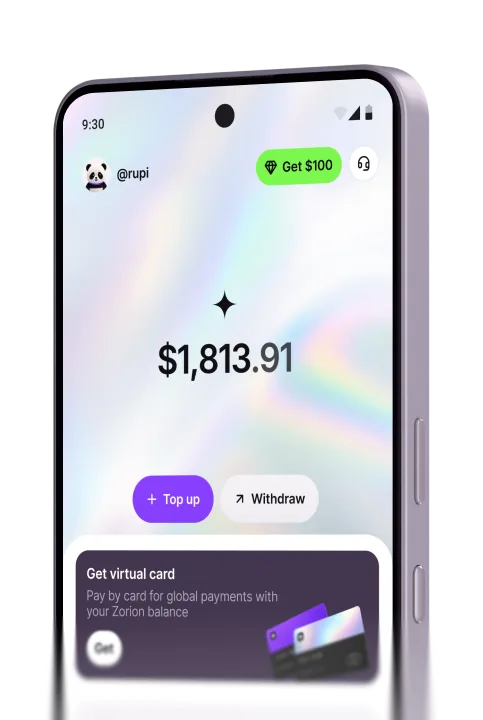
Zorion takes a different approach. Your balance sits in USD/USDT, so the virtual card spends directly in the same currency as most international billing. No extra conversion layer, just paying one subscription.
Beyond currency, there’s a second limit worth knowing before signing up for SpectroCoin. The card is issued only to citizens or permanent residents of the EEA plus the UK. That’s an explicit list of roughly 30 countries, and it doesn’t include Indonesia. So this isn’t just a case of an inconvenient currency. It’s a question of who can even get the card in the first place.
What SpectroCoin actually is
SpectroCoin is a Lithuania-based crypto wallet and exchange that has been running since 2013. Beyond buying and selling crypto, it offers a physical and virtual Visa card. Here’s how funding works: crypto held in your SpectroCoin wallet gets converted into euros. That euro balance becomes your card balance. The card itself is issued by UAB Pervesk, an electronic money institution licensed by the Bank of Lithuania. It’s a regulated setup with a clear paper trail, not some fly-by-night app.
SpectroCoin’s genuine strengths, stated plainly
It’s fair to give SpectroCoin credit for what it does well. Daily limits run high — up to €25,000 for POS and online purchases, €2,500 for ATM withdrawals. Loading the card from the wallet is free, with no extra charge on top-ups. Apple Pay support is confirmed, and the company has been operating for well over a decade. It’s not a startup that could vanish overnight. A single account can hold up to 5 physical cards and 99 virtual cards. That’s useful if you genuinely need separate cards for separate purposes.
On fees: a physical card costs €5 to issue, a virtual card €1. There’s a €1 monthly service charge, €15 for a replacement, and €6 to renew. POS transactions are free in euros within the EEA, cost 0.5% for other currencies within the EEA, and 1% outside the EEA. ATM withdrawals run €1 flat in the EEA in euros, 1% (minimum €1) for non-euro EEA withdrawals, and 2% (minimum €2) internationally.
Verification and KYC on SpectroCoin
The process is fairly thorough. SpectroCoin asks for a government ID, a selfie, and a KYC questionnaire covering PEP status and beneficial ownership. It also requires a verified phone number. For the fiat card specifically, it also requires a Tax Identification Number and your country of tax residence. That step exists, SpectroCoin says, to meet obligations owed to its card-issuing partners. Verification usually takes a few hours to two business days. It can stretch to 10 days if anything needs a second look.
Zorion vs spectrocoin: which scenario fits you
If you’re outside the EEA and UK and want a balance that sits in dollars to match dollar-billed subscriptions, that’s the case for you. Zorion vs spectrocoin tilts clearly toward Zorion here. That’s not just about who’s eligible. A USD balance is simply a better match for USD bills without a conversion layer in between. If you’ve just cashed out winnings from a trading platform and want the money in an Indonesian bank account, that path exists too. Zorion has a direct rail through Monetix. SpectroCoin has no equivalent path to an Indonesian bank at all. It isn’t an option for that use case, regardless of KYC effort.
On the other hand, say you’re a citizen or permanent resident of an EEA country or the UK. If most of your spending already happens in euros, the picture changes. SpectroCoin’s card is a reasonable fit there — the limits are high and top-ups are free. But for anyone outside that region, the card simply isn’t available, no matter how complete the paperwork is.
Frequently asked questions
Zorion fits when your balance and your bills are both in dollars
If most of what you pay for — ChatGPT Plus, Netflix, Spotify — is billed in dollars, that’s reason enough. There’s no need to add a euro layer in between. Zorion holds your balance in USD/USDT, and the virtual card spends in that same currency. There’s no double conversion every time you pay. After cashing out from a trading platform, you can send funds straight to an Indonesian bank account through Monetix. Or move them out to crypto through changecoins.io. Try it and see the difference for yourself.
Keep reading
Zorion vs Kast: Is a $1,000+/Year Crypto Card Membership Worth It?
Your balance sits in USD, ready to spend on a virtual card the next time a subscription or an online
Zorion vs Oobit: Do You Need Your Own Crypto Wallet First?
You want to spend it on Netflix or ChatGPT. You search zorion vs oobit because both names keep showing up together. Before
Zorion vs RedotPay: Free Virtual Card or Pay $10-$100 First?
You just cashed out your winnings from a trading platform, converted to USDT, and now you’re looking for a way to spend that balance on international services —…