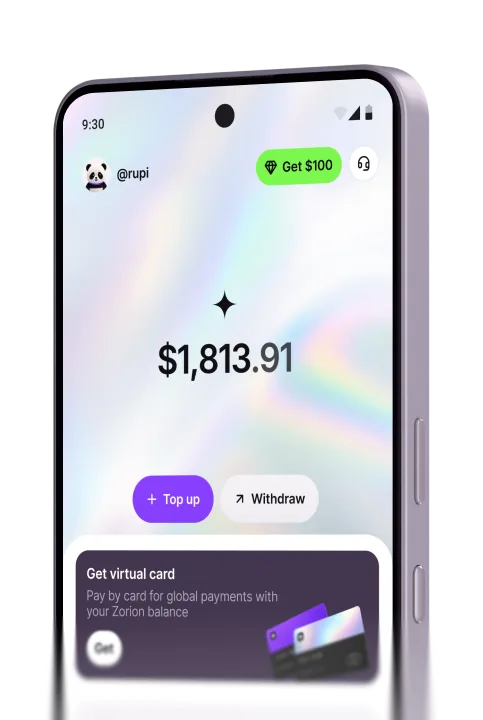
Cards & Payments
Zorion vs RedotPay: Free Virtual Card or Pay $10-$100 First?
You just cashed out your winnings from a trading platform, converted to USDT, and now you’re looking for a way to spend that balance on international services — subscriptions, shopping on a foreign platform, or topping back up to trade again. One name that keeps coming up when you search ”crypto card” is RedotPay. Before you sign up, there’s one number worth checking first: RedotPay charges $10 to $100 just to issue the card, before you’ve spent a single dollar. This Zorion vs RedotPay comparison lays out the facts as they are — how RedotPay actually works, what it really costs, and which situations fit which wallet better.
Zorion vs RedotPay: what you pay before you spend anything
RedotPay charges an upfront card issuance fee: $10 for a virtual card, $100 for a physical one, with no annual fee after that. Once the card is active, same-currency spending is free. But spend at a merchant in a different currency and there’s a 1.2% conversion fee. If you’re still holding crypto and want to spend it directly on a fiat purchase, there’s a 1% crypto-to-fiat conversion fee on top. Certain merchant categories — ad platforms and gaming apps — carry an extra 1.5% fee (minimum $0.50, with 3 waivers per card per month). ATM withdrawals cost 2% up to $10,000 a month, rising to 3% above that.
Here’s a concrete example. Say you just cashed out $300 from a trading platform, converted it to crypto, and want to spend it on an international service. Crypto-to-fiat conversion at 1% is $3, plus currency conversion at 1.2% is $3.60 — that’s $6.60 already. Add the $10 virtual card fee upfront, and $16.60 is gone before you’ve bought anything. Zorion doesn’t charge a separate card issuance fee — the virtual card comes bundled with your USD balance, so that $16.60 stays in your account instead.
How RedotPay works: the just-in-time conversion model
RedotPay is a Hong Kong-based crypto payment platform that issues virtual and physical Visa cards. It supports BTC, ETH, BNB, SOL, SUI, TRX, XRP, USDT, and USDC across multiple networks. What sets RedotPay apart from a standard prepaid card is its ”just-in-time” model: your crypto stays in your wallet as-is, and only converts automatically the moment you tap the card at checkout. It isn’t a pre-funded fiat balance sitting ready like a traditional wallet — you need actual crypto assets, on the right network, every time you spend.
RedotPay’s genuine strengths
In any honest Zorion vs RedotPay comparison, this section is just facts worth acknowledging. RedotPay charges nothing at all when you spend in the same currency your crypto balance is held in. Its fee structure is published clearly on its own site, so there’s no hidden surprise buried in fine print. Asset support is broad — nine cryptocurrencies across multiple blockchain networks. And it’s registered across a wide range of countries, giving it a fairly large footprint as a crypto card provider.
RedotPay’s KYC and account verification
To open an account, RedotPay requires you to be 18 or older, provide your full legal name and date of birth matching an official document, submit a government ID (an original physical document valid for at least 3 more months), complete a biometric face scan, provide an address, and answer a brief source-of-funds questionnaire. Only one verified account is allowed per person. The process is thorough — reasonable for a financial platform — but it does require an original physical document, not just a photo pulled from your phone’s gallery.
Zorion vs RedotPay: which one fits your situation
If you just cashed out from a trading platform to rupiah and want that money to land in a bank account, RedotPay doesn’t publish a page documenting a direct IDR bank payout — its product is built around holding and spending crypto value, not converting it into a local bank account. Zorion has that path through Monetix, straight from your USD wallet balance to an Indonesian bank account.
If you don’t want to pay $10 to $100 upfront just to get a card, that’s another reason people look elsewhere. Zorion’s virtual card comes bundled with the wallet, with no separate issuance fee.
And if you’re still new to crypto and haven’t gotten used to holding assets across several different blockchain networks, RedotPay’s just-in-time model can feel like extra homework — you need to know which asset sits on which network before you spend. Zorion turns USDT into a simple USD balance inside the wallet, so there’s no network to pick every time you use the card. If you ever want to convert back to crypto, that’s available too, through changecoins.io.
Frequently asked questions
Zorion: start without paying upfront
That’s the concrete gap in Zorion vs RedotPay: no $10-$100 fee just to get a card, your USDT turned into a simple USD balance with no network to pick, and a direct payout path to a bank account through Monetix if you want your money in cash, or to crypto through changecoins.io if you’d rather keep holding digital assets. Try it yourself and see the difference.
Keep reading
Zorion vs Kast: Is a $1,000+/Year Crypto Card Membership Worth It?
Your balance sits in USD, ready to spend on a virtual card the next time a subscription or an online
Zorion vs Oobit: Do You Need Your Own Crypto Wallet First?
You want to spend it on Netflix or ChatGPT. You search zorion vs oobit because both names keep showing up together. Before
Zorion vs SpectroCoin: A Euro Card for Dollar Bills?
Now you want to pay for ChatGPT Plus, billed at $20. You start looking for a card that can be funded straight from