Cards & Payments
Why Is My Card Declined for International Payments?
Your card works fine at the local coffee shop. Then it gets rejected the moment you try to pay for a Netflix subscription or renew ChatGPT Plus. Nothing about your balance changed between those two purchases. Sending money to family abroad hits the same wall, and topping up an international game server does too. Why is my card declined for international payments when it works everywhere else? The short answer: your bank is blocking it on purpose, usually for one of five specific reasons. Each one has its own fix.
Why Is My Card Declined for International Payments? The 5 Real Causes
Before digging into each cause, it helps to know the pattern. A decline abroad almost never means you did something wrong. It means your bank’s fraud system flagged the charge as unusual. Here, unusual mostly means ”outside the country you normally spend in.”
1. International transactions aren’t switched on
Plenty of debit cards ship with cross-border and online payments switched off by default. The bank isn’t reacting to your specific charge. The whole category of foreign transactions stays closed until you open it yourself. Check your banking app for a toggle labeled something like ”international transactions” or ”overseas payments.” If there’s no toggle, call the bank and ask directly.
2. Your bank flagged the merchant as suspicious
A $9.99 charge from ”Netflix International” in Los Angeles doesn’t match your normal spending history. Neither does a payment to OpenAI in San Francisco. The fraud engine treats a first-time foreign merchant as risk, even when the amount is small. It’s the same system that would flag a stranger using your card abroad. It just can’t always tell the difference between that and you.
3. Currency mismatch
A card provisioned only for your home currency sometimes can’t process a foreign-currency charge. Instead of converting it automatically, some banks reject the charge outright and leave you to figure out why. If the merchant bills in a currency your card wasn’t set up for, the charge simply fails. It’s one of the most common reasons a payment fails despite a healthy balance.
4. 3-D Secure or OTP verification failed
Foreign checkout pages trigger the same OTP step your bank uses locally. The SMS can take longer to arrive while you’re roaming. Meanwhile, the merchant’s 3-D Secure page can time out before the code even shows up. Miss that window by even 30 seconds, and the payment gets declined as a failed verification. That’s not the same as a fraud block.
5. Merchant category block
Some banks block entire merchant categories outright: crypto exchanges, forex platforms, and anything coded like online trading. Say you’ve moved winnings from a trading platform into your bank, then tried to spend them straight at a foreign merchant. That’s often the real reason it stalls. The merchant category code, not your balance, triggered the block.
Why Is My Card Declined for International Payments Even With Enough Balance?
This is the complaint we hear most. ”I have Rp 500,000 in the account, the subscription only costs Rp 160,000 — why is it still declined?” The math is usually a hold, not a shortfall. Banks place a temporary authorization for more than the sticker price, to cover currency conversion swings. That buffer is sometimes 10-20% above the charge. A Rp 160,000 subscription can trigger a Rp 190,000 hold. If your balance sits at Rp 170,000, the merchant price technically clears, but the hold fails. The app just shows ”declined,” with no breakdown of why.
Fix a Declined Card in 5 Minutes
When This Usually Shows Up
The pattern repeats in a handful of situations. Someone cashes out profits from a trading platform and moves the IDR into their bank. They then try to pay for ChatGPT Plus with the same debit card and get declined twice in a row. Another person sends money to a parent in another country and watches the transfer bounce back with no real explanation. Gamers topping up Mobile Legends or PUBG through a foreign payment gateway hit the same wall mid-purchase. It happens right when they need the top-up fastest. In every case, the balance was never the actual problem.
Mistakes That Make It Worse
Understanding why is my card declined for international payments only helps so much. A few common habits can undo the fix just as fast. Retrying the exact same charge five times in a row often makes things worse. Each attempt can look like a fraud pattern to the bank, rather than a shopper trying to pay. Entering a billing address that doesn’t match your card on file is another common one. Even a missing apartment number can trip the check. People also assume a decline means their account is compromised, so they freeze it themselves. That just adds a second block on top of the first. Plenty of people never call their bank at all. It feels easier to try a different card than to sit on hold for ten minutes.
Frequently asked questions
A Zorion Card Doesn’t Hit These Blocks
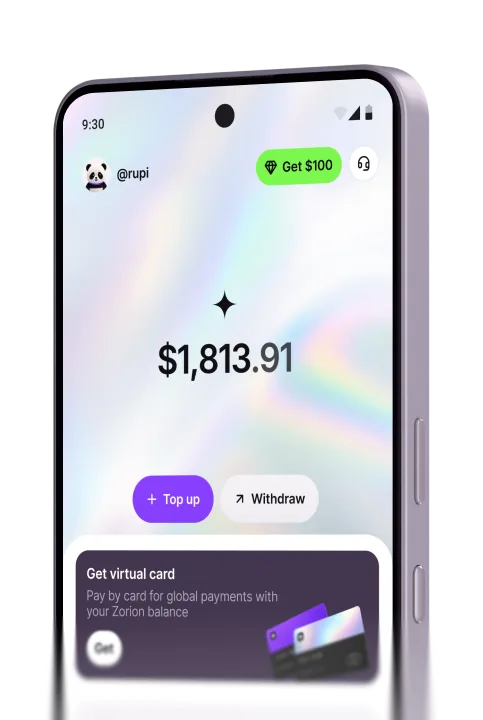
Every cause above comes down to the same thing. A local debit card built for domestic spending is being asked to do something it wasn’t set up for. Zorion’s virtual card is built the other way around: international by default. There’s no toggle to find and no currency mismatch on a USD checkout. There’s also no merchant category flag on a subscription payment or a trading payout. Fund it from your Zorion balance and use it for Netflix, ChatGPT, or sending money abroad. It clears the kind of charge that gets local cards declined. Anyone can sign up and try Zorion today.
Keep reading
Zorion vs Kast: Is a $1,000+/Year Crypto Card Membership Worth It?
Your balance sits in USD, ready to spend on a virtual card the next time a subscription or an online
Zorion vs Oobit: Do You Need Your Own Crypto Wallet First?
You want to spend it on Netflix or ChatGPT. You search zorion vs oobit because both names keep showing up together. Before
Zorion vs RedotPay: Free Virtual Card or Pay $10-$100 First?
You just cashed out your winnings from a trading platform, converted to USDT, and now you’re looking for a way to spend that balance on international services —…