QRIS & Indonesia
Zorion vs ShopeePay: Even the Top Tier Can’t Pay a Dollar Bill
Picture this: you just cashed out your winnings from a trading platform, your ShopeePay balance is topped up, and now you want to pay for ChatGPT Plus at $20 a month so you can actually use it for work. You open the app, look for a way to pay, and there isn’t one. ShopeePay can’t be used to pay anything billed in US dollars. That’s not a bug — it’s how the product was built from day one. This is where Zorion vs ShopeePay really comes down to two products built for completely different jobs, not one app simply being ”better” than the other.
What ShopeePay actually is, and what it’s built for
ShopeePay is Shopee’s e-wallet, regulated by OJK and Bank Indonesia, and millions of people already use it for everyday spending. Its feature set is broad: checkout inside the Shopee marketplace, QRIS payments at physical stores, topping up mobile credit and paying utility bills, booking food delivery and couriers, sending money to other users, transferring to banks or other e-wallets, and cash withdrawal. There’s also ShopeePay Later and SPinjam for installment purchases or quick loans. Every one of these runs on a Rupiah balance, and that’s by design, not a shortcoming — the product was never meant to hold anything else.
Zorion vs ShopeePay: where the balance cap stops you from paying in dollars
This is the part that catches people off guard. A Standard ShopeePay account caps out at Rp2,000,000 in balance, with monthly inflow limited to Rp20,000,000, and QRIS or online payments capped at Rp2,000,000 per transaction. Upgrade to Plus and the ceiling moves, but not by much: max balance Rp20,000,000, monthly inflow Rp40,000,000, QRIS payments up to Rp10,000,000, and online payments up to Rp20,000,000. That Rp20 million works out to roughly $1,250 — and that’s the highest tier available, not a typical daily limit.
The bigger issue isn’t the number, though. Every rupiah of that balance stays in Rupiah, and ShopeePay has no card to spend it on international sites. The one feature that touches cross-border payment is called QR Cross-Border, and it only works for scanning a physical merchant’s QR code while you’re actually in Singapore, Malaysia, Thailand, or Japan, paid out of your Rupiah balance with a 1.3% conversion fee. It explicitly doesn’t cover online payments to services abroad like Netflix, Spotify, or ChatGPT. So even with the full Rp20 million sitting in the account, there’s still no way to pay a bill quoted in dollars. That’s the real difference at the heart of Zorion vs ShopeePay: one side has a virtual card running on a USD/USDT balance, the other has no card at all.
What ShopeePay genuinely does well
It’s worth being fair about where ShopeePay holds up. Its integration with the Shopee marketplace is tight — checkout, promos, and cashback all flow together automatically. QRIS acceptance is wide across physical stores in Indonesia, and small merchants pay 0% MDR, which makes it friendly to local businesses. The lifestyle ecosystem is broad too: electricity, water, mobile credit, and ride bookings all live in one app. Transfers to other users are free for the first 10 a month (transfers to SeaBank stay free indefinitely), with a Rp2,500 fee after that. Topping up from DANA costs around Rp999 in admin fees plus Rp500 on arrival, with a Rp10,000 minimum. As a regulated domestic wallet, ShopeePay is a solid, trusted choice for everyday spending inside Indonesia.
Realistic scenarios where the gap shows up
Someone who just pulled a win off a trading platform usually needs two things: getting the money into a bank account or crypto, and sometimes spending part of it on something billed abroad. That’s exactly where the gap becomes obvious. Trying to pay for Netflix or Spotify, both billed in dollars? No foreign merchant accepts QRIS or Rupiah directly, and ShopeePay has no card to offer instead — the payment simply can’t go through. Booking an international flight on a foreign airline’s website that asks for a Visa or Mastercard? Same story, ShopeePay has nothing to offer there either. Even being physically outside the four or five countries QR Cross-Border supports, or standing at a merchant that doesn’t take QRIS, leaves that feature useless too. It’s the same pattern every time someone lines up Zorion vs ShopeePay: the question isn’t which app has better promos, it’s whether there’s any path at all to holding and spending a dollar balance.
Frequently asked questions
Zorion vs ShopeePay: what this means for you
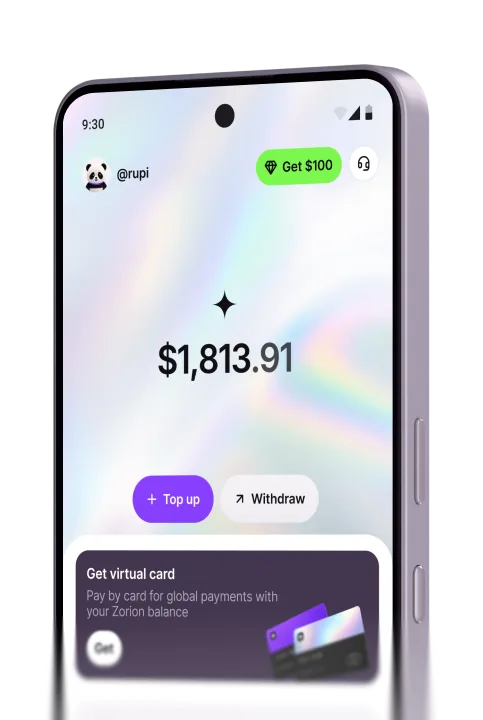
If everything you spend on is domestic, ShopeePay already covers it. But the moment you need to pay for Netflix, Spotify, ChatGPT Plus, or anything billed in US dollars, that’s not something an account upgrade fixes — it’s a card that simply doesn’t exist. Zorion holds a USD/USDT balance you can spend directly through a virtual card anywhere Visa or Mastercard is accepted, and you can still cash it out to an IDR bank account through Monetix or to crypto through changecoins.io whenever you want. That’s the real difference between Zorion vs ShopeePay for anyone who regularly pays for something priced abroad.
Keep reading
Zorion vs DANA: Free Transfers, But No Way to Pay International Bills
The balance lands instantly. It works fine for QRIS at the minimarket, topping up phone credit, or sending money to a
Zorion vs GoPay: Why GoPay Can’t Pay for Netflix or ChatGPT Plus
Then you try to subscribe to ChatGPT Plus for work or Netflix for the weekend, and the
Zorion vs OVO: Why OVO Can’t Pay for International Subscriptions
The balance landed in OVO, and you try to pay for ChatGPT Plus at $20 a month. The payment keeps getting declined, even though the balance is there.